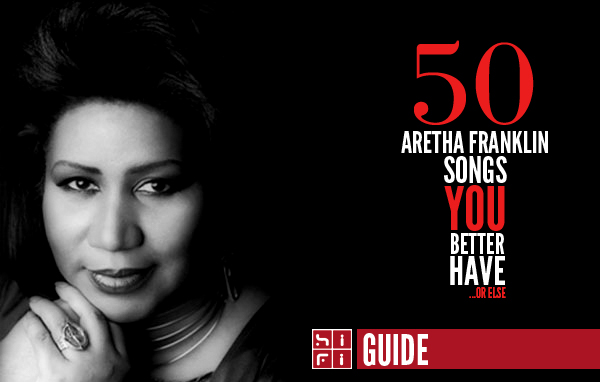
50 Aretha Franklin Songs You Better Have…Or Else
 “See Saw”
(1968; #14 pop)
Writer: Steve Cropper, Don Coway
Producer: Jerry Wexler
from the album Aretha Now
See saws actually don’t “go all around,” but that lyrical faux pas didn’t hinder Aretha from making you believe it. In Franklin’s world, Don Coway’s choice of words may have properly described the kind of drama that defined her relationship with ex-hubby and former manager Ted White (R&B singer Bettye LaVette described White as a pimp and abuser, someone she also slept with). Inside the gold-certified hit “See Saw,” Franklin does a great job in detailing a rocky love affair: “You lift me up when I’m on the ground/But as soon as I get up top, you send me tumblin’ down.” Franklin, who remains tight lipped about the sour days of that marriage, would divorce her White for good in 1969.
 “Wholy Holy”
(1972, #81 pop)
Writer: Al Cleveland, Renaldo Benson, Marvin Gaye
Producer: Jerry Wexler, Aretha Franklin
from the album Amazing Grace
First appearing on Marvin Gaye’s triumphant socio-political record What’s Going On, “Wholy Holy” stands out as one the Motown star’s most revered spiritual moments ever. It also made it to vinyl after Gaye fought desperately for creative control over his career, something label president Berry Gordy protested against formerly. In fact, he initially hated hearing “What’s Going On,” calling it “the worst thing I ever heard in my life.” The album was finally released, giving the reinvented Gaye a major jump in his career. By 1972, Franklin was still the reigning queen in her genre. She also recognized that gospel music was now crossing more into her element with the success of Edwin Hawkins’s “Oh, Happy Day” and George Harrison’s “My Sweet Lord.” Wexler claims it was his idea for Franklin to record a gospel record on Aretha. She says it was her idea. Regardless of whose idea it was, the two nights at the New Temple Missionary Baptist Church in South Central L.A. was a definite return to her Christian roots. “Wholy Holy,” sweetened by the angelic voices of Rev. James Cleveland’s super choir, was used as the album’s only single. It only managed to reach the lower branches of the Hot 100, but forget about radio; Amazing Grace had amazing powers. It became Franklin’s only album to go double-platinum and remains her best-selling album of her career.
 “Love All The Hurt Away”
(1981; #46 pop)
Writer: Sam Dees
Producer: Arif Mardin
from the album Love All The Hurt Away
A dreamy sophisticated pop ballad – “Love All the Hurt Away” does the most in transporting Franklin into a Roberta Flack/Donny Hathaway scenario with R&B/jazz singer George Benson. A union of this sort on such an AC-ready tune may have come with a number of gripes that the soul inside Lady Soul was losing steam, but it proved wholeheartedly that Franklin could even sing something this lightweight and honor it with high levels of integrity and class. Despite the album’s sagging sales, the single managed to reach number 46 pop and number 6 r&b. Listen to Arif Mardin’s touches on this pillar of romance and you can pick up where Whitney Houston and Freddie Jackson brushed up their slow jams on.
 “I Knew You Were Waiting (For Me)”
(1987; #1 pop)
Writer: Simon Climie, Dennis Morgan
Producer: Narada Michael Walden
from the album Aretha
George Michael, a hunky Greek god twenty years younger than Aretha, teamed up with the soul veteran for all the right reasons. Firstly, he needed to get away from the safe MOR pop that decorated Wham! and the disparaging criticisms that plagued his kind of soul. Secondly, he needed to build up the trust of the American people about the directions of his international solo career. “As a concept it was certainly ballsy and shrewd,” Clive Davis said in his autobiography, The Soundtrack of My Life. “Meanwhile, from the other perspective, it would be great for Aretha to reach a young audience all over the world that George would inevitably bring with him. I was sold.” The song – originally constructed as a country song – fell into the hands of producer Narada Michael Walden and quickly rose to number one in a matter of nine weeks, becoming the biggest hit in Aretha’s career since “Freeway of Love.”
 “Spanish Harlem”
(1971; #2 pop)
Writer: Jerry Leiber, Phil Spector
Producer: Jerry Wexler, Tom Dowd and Arif Mardin
from the album Aretha’s Greatest Hits
A fearless daredevil for song arrangements, Franklin took the Ben E. King classic and whipped it into a mesmeric cloud of subdued funk and spunky r&b. Much of the Spanish elements from the original were still on board, but Dr. John’s keyboards and Franklin’s soulful backing singers added an extra layer of energy to the mix. Franklin, knocking on James Brown’s “I’m black and I’m proud” door, also seasoned the lyrics with a minor change. Instead of “a red rose up in Spanish Harlem,” Franklin sung “There’s a rose in Black in Spanish Harlem.” It was her second King cover to date; “Don’t Play That Song (You Lied)” came first in 1970.
 “Baby, Baby, Baby”
(1967)
Producer: Jerry Wexler
Writer: Aretha Franklin, Carolyn Franklin
from the album I Never Loved a Man the Way I Love You
A jewel stashed towards the back of the first side of Franklin’s Atlantic debut, “Baby, Baby, Baby” struts like “Earth Angel,” but bursts open some of the most agonizing, regretful and painful lyrics to hit Aretha wax. She goes for Luther Ingram pain way before his 1972 tune (“Because if loving you was so wrong/Then I’m guilty of this crime”) and then agonizes over her lovelorn pain by injecting scorn on her own consciousness (“I didn’t mean to hurt you/Don’t you know that I’d rather hurt myself”). If there was any proof that Aretha was called to preach the blues, this was the one record to show off. The track managed to sneak up on the B-side of “A Natural Woman” in 1967.
 “A Deeper Love”
(1993; #63 pop)
Writer: David Cole, Robert Clivillés
Producer: David Cole, Robert Clivillés
from the album Greatest Hits: 1980-1994
Aretha didn’t do so well when she was being fitted for disco in the Seventies, but she certainly made up for lost time when Clivillés & Cole, the masters behind C+C Music Factory, produced her cover of their UK Top 20 hit “Deeper Love” for the motion picture soundtrack of Sister Act 2. Franklin sung the dance track as if she had done her homework on disco divas like Loleatta Holloway, who had just been resurrected through a sample on Marky Mark and the Funky Bunch’s “Good Vibrations” in 1991. She squalls and uses her gospel-trained pipes to turn the song into a track fitting for Sylvester. Amazingly, the song vaulted to number one on the Billboard Dance charts.
 “Spirit in the Dark”
(1970; #23 pop)
Writer: Aretha Franklin
Producer: Arif Mardin, Jerry Wexler and Tom Dowd
from the album Spirit in the Dark and Live in Fillmore West
“Catching the spirit” is church lingo most Protestants are familiar with. It’s a term that loosely defines the charismatic flow of paranormal activity led by the charge of the Holy Spirit. And like Ray Charles did with his gospel-pruned shouters (“I Got a Woman,” “What’d I Say”), Aretha Franklin had devised a way for her worldly counterparts to taste of the Lord’s goodness without getting too preachy. “Do you feel like dancing?,” Aretha asks at the top of the song. She then belts out “get up and let’s start dancing” as if she’s the preacher of the hour. Her 1970 version, featuring the Dixie Flyers, was a decent exercise that walked on the same waters of Wilson Pickett’s “Mustang Sally,” but an epiphany takes place at Bill Graham’s Filmore West in March 6, 1971 when Ray Charles joins Aretha on stage for a nine-minute rollercoaster ride of sexy, passionate gospel-soul. On the culled down mine-minute reprise of Franklin’s last finale, the two flirt with one another in ways that have never been duplicated on a Lady Soul duet since.
About the Author

- Related:
- ahmet ertegun
- annie lennox
- aretha franklin
- arif mardin
- cissy houston
- clive davis
- Cover Story
- dave stewart
- donny hathaway
- duane allman
- eurythmics
- hifi guide
- jermaine dupri
- jerry wexler
- lauryn hill
- luther vandross
- narada michael walden